
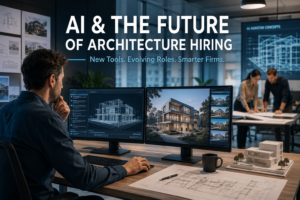
Most architecture firms are still talking about AI as a design tool.
The smarter firms already understand the bigger shift: AI is changing hiring.
Over the next few years, architecture firms won’t just hire differently because technology is improving. They’ll hire differently because the work itself is changing.
Some tasks will become automated. Some production-heavy roles will shrink. And architects who combine technical ability with communication, leadership, and client-facing skills will become dramatically more valuable.
The firms that adapt early will have a major advantage in recruiting and retention.
## AI Will Reduce Repetitive Production Work
Artificial intelligence is already beginning to reshape repetitive production tasks across architecture firms. Drafting automation, rendering tools, BIM assistance, and documentation support are becoming more advanced every year.
Tasks that once took hours can now be completed in minutes.
That doesn’t mean architects are being replaced. But it does mean firms may rely less on purely production-focused roles over time.
Junior architects and designers who focus only on technical execution may find themselves competing in a very different environment over the next several years.
## Firms Will Prioritize Strategic Thinkers Over Pure Technicians
As AI handles more production assistance, firms will increasingly value architects who bring strategic thinking to projects.
Skills like:
– Client communication
– Leadership
– Coordination
– Problem-solving
– Design strategy
– Business development
…will become even more important.
AI can assist production. It cannot replace trust.
Architecture has always been a relationship-driven business. Clients still want experienced professionals who can guide projects, solve problems, and communicate effectively under pressure.
The architects who stand out in the future won’t simply be the best software users. They’ll be the professionals who can combine technical expertise with leadership and critical thinking.
## The Best Architects Will Use AI Instead of Fighting It
Every major technological shift in architecture has created fear at first.
CAD changed architecture. BIM changed architecture. Remote collaboration changed architecture.
AI will do the same.
The firms and professionals who benefit most won’t be the ones resisting change. They’ll be the ones learning how to use new tools to improve efficiency and workflow.
AI can already help with:
– Concept generation
– Rendering
– Visualization
– Documentation support
– Workflow efficiency
– Specification assistance
Architects who embrace these tools intelligently may become significantly more productive than those who ignore them.
## Hiring Managers Will Need to Evaluate Different Skills
Architecture firms may also need to rethink how they evaluate talent during the hiring process.
For years, many firms focused heavily on technical software proficiency. While software knowledge still matters, future hiring decisions may place greater emphasis on:
– Adaptability
– Communication skills
– Leadership potential
– Collaboration
– Critical thinking
– Client interaction
A candidate who knows Revit but struggles to lead meetings or communicate with clients may face limitations in the evolving industry.
The future of architecture hiring may increasingly favor well-rounded professionals over purely technical specialists.
## Smaller Firms May Gain a Competitive Advantage
One of the more interesting effects of AI could be how it impacts smaller architecture firms.
Historically, larger firms often held advantages in staffing, production capacity, and resources.
AI tools may help level that playing field.
Lean firms could potentially:
– Produce work more efficiently
– Reduce overhead
– Compete for larger projects
– Improve turnaround times
– Operate with smaller teams
This may allow smaller firms to become more competitive both operationally and in recruiting top talent.
## Final Thoughts
Architecture isn’t becoming less human because of AI.
If anything, the opposite is happening.
As automation handles more repetitive production work, the architects who stand out will be the ones who can think strategically, communicate clearly, lead teams, and build client trust.
The firms that recognize this shift early won’t just hire better talent.
They’ll build stronger businesses.
## Contact Information
If your architecture or AEC firm is preparing for the next evolution of hiring, now is the time to start thinking differently about talent.
At Leadmark Group, we help firms identify and recruit high-performing architecture and engineering professionals who can thrive in a rapidly changing industry.
Matt Anderson
Leadmark Group
Phone: 240-409-8600
Email: manderson@leadmarkgroup.com
Website: https://www.leadmarkgroup.com