
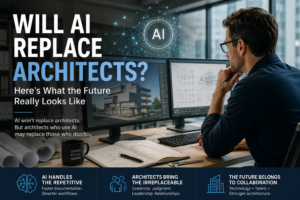
Artificial intelligence has quickly become one of the hottest topics in architecture. Every week there seems to be another AI tool promising to generate floor plans, create renderings, write specifications, or even design entire buildings.
It’s understandable that many architects are asking the same question:
Will AI replace architects?
My answer is no—but it will absolutely change the profession.
As someone who has spent more than two decades recruiting architects across the United States, I believe AI will reshape how architecture firms operate. The firms that embrace it will become more efficient and more profitable. Those that ignore it risk falling behind.
AI Will Eliminate Tasks, Not Architects
Throughout history, technology has changed the way architects work.
Hand drafting gave way to CAD.
CAD evolved into Revit and BIM.
Today, AI is the next major leap.
Rather than replacing architects, AI is taking over repetitive, time-consuming tasks that consume hours every week.
These include:
- Creating initial design concepts
- Producing renderings
- Drafting construction documents
- Coordinating BIM models
- Performing code research
- Writing project narratives
- Reviewing drawings for inconsistencies
- Generating meeting notes and summaries
Instead of spending hours on routine production work, architects will be able to focus on design, client relationships, and solving complex problems.
Junior Roles Will Change the Most
The greatest impact will likely be felt at the entry level.
Many firms traditionally hired junior architects to perform drafting, modeling, redlines, and documentation. AI can already complete many of these tasks much faster than it could just a few years ago.
That doesn’t mean firms will stop hiring young architects.
It means those architects will need to develop higher-value skills earlier in their careers, including:
- Communication
- Client interaction
- Project coordination
- Design thinking
- Leadership
- Problem solving
Technical skills will remain important, but they won’t be enough on their own.
Experienced Architects Become Even More Valuable
AI cannot replace trust.
Clients hire architects because they rely on their judgment, experience, and ability to navigate complicated projects.
Experienced professionals who can:
- Lead teams
- Build client relationships
- Manage consultants
- Make difficult design decisions
- Mentor younger staff
- Win new business
will become even more valuable as AI handles more production work.
Architecture Firms May Need Fewer People
This is the difficult reality many firms are beginning to consider.
If AI allows one experienced architect to complete the work that previously required several production staff, firms may eventually reduce hiring for certain positions.
Over the next decade, architecture firms could produce significantly more work with leaner teams.
That doesn’t necessarily mean fewer projects.
It means greater productivity per employee.
New Career Opportunities Will Emerge
Every major technological shift creates new jobs.
AI is no different.
We are already seeing demand for professionals who understand:
- AI-assisted design workflows
- BIM automation
- Computational design
- Digital practice management
- AI implementation within architecture firms
Architects who learn these technologies early will have a competitive advantage.
What This Means for Hiring
As an architecture recruiter, I believe hiring priorities will shift over the next several years.
Firms will increasingly look for professionals who combine technical expertise with leadership and communication skills.
Licensed Project Architects, Project Managers, Studio Leaders, and Design Directors will likely remain in high demand because their value extends far beyond producing drawings.
The ability to lead projects, manage clients, and make sound decisions will become even more important in an AI-driven industry.
Final Thoughts
AI isn’t coming to architecture.
It’s already here.
The firms that treat AI as a productivity tool—not a replacement for people—will likely gain a significant competitive advantage.
Likewise, architects who embrace AI rather than fear it will position themselves for long-term success.
The future belongs to architects who combine technology with creativity, leadership, and sound professional judgment.
AI won’t replace great architects.
But great architects who use AI may very well replace those who don’t.
About the Author
Matt Anderson is President of Leadmark Group, a national executive search firm specializing in recruiting architects and design professionals. Since 2004, Leadmark Group has partnered with architecture firms across the United States to identify exceptional talent for leadership, project management, and technical positions.
manderson@leadmarkgroup.com
240-409-8600